NEMA 250 Type 4X is far more demanding than basic rain or splash protection. For an enclosure to survive industrial washdown lines and coastal storms over a multi-year service life, its door geometry, continuous gasket chemistry, latch compression points, and roof slope must act together as a unified mechanical pressure seal.
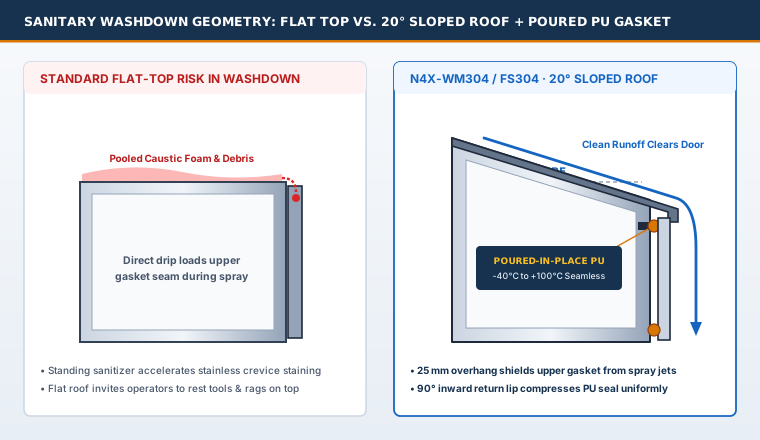
What NEMA 250 Type 4X Environmental Validation Covers
Under NEMA 250 environmental criteria, Type 4X enclosures are designed to protect personnel from hazardous parts and shield internal electrical assemblies against:
- Windblown Dust & Falling Dirt: Complete dust-tight exclusion across doors, seams, and cable gland plates.
- Hose-Directed Pressurized Water: High-volume water streams directed across every seam, hinge line, and latch perimeter from a standard 1-inch (25.4 mm) nozzle at specified flow rate and distance without water entering the electrical compartment.
- External Ice Formation: Structural integrity when ice builds externally on top, hinges, and door edges without damaging the enclosure or breaching sealing flanges.
- Corrosion Resistance (“X” Designation): Resistance to corrosive agents and coastal salt-spray exposure—the critical differentiator separating Type 4X stainless steel enclosures from painted carbon-steel Type 4 housings.
Every N4X enclosure is built to NEMA 250 Type 4X and UL 508A enclosure design requirements; material mill certificates (304/316L) and ingress test reports available per project.
Continuous Poured-in-Place PU vs. Glued Strip Gaskets
Why do field washdown leaks happen after 6–18 months even on stainless cabinets? The #1 culprit is miter-glued adhesive foam tape peeling away at door corners after repeated thermal cycling and caustic detergent exposure.
| Sealing Attribute | Continuous Poured-in-Place PU (Standard) | Optional Blue FDA Silicone | Adhesive Foam Strip (Avoided) |
|---|---|---|---|
| Corner Continuity | Seamless 360° robot-dispensed loop | Seamless molded or vulcanized loop | 4 butt-glued corners prone to peeling |
| Service Temperature | -40°C to +100°C (-40°F to +212°F) | -50°C to +180°C (-58°F to +356°F) | Narrow thermal & caustic tolerance |
| Compression Recovery | High closed-cell rebound over thousands of cycles | High rebound in hot steam / CIP spray | Permanent compression set over time |
| Sealing Edge Design | Compresses against 90° inward return knife-edge | Compresses against 90° inward return lip | Often flattened on flush door faces |
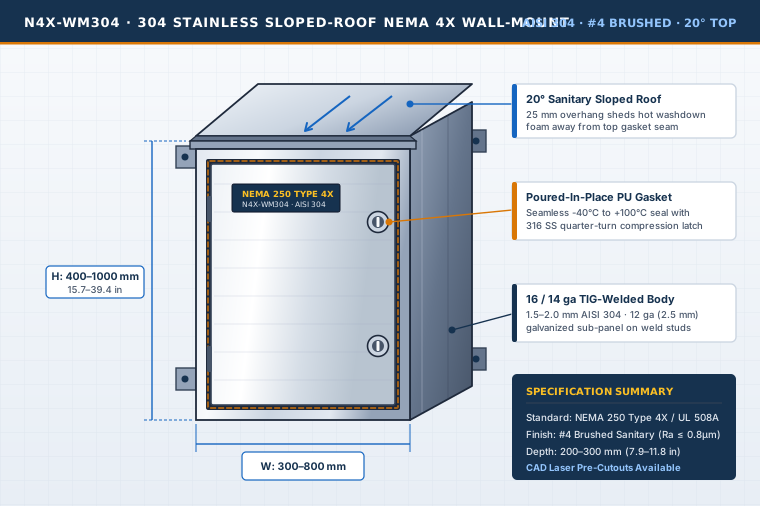
Latch Spacing, Knife-Edge Return Lips & Gland Sealing
Gasket chemistry alone cannot hold back a pressurized washdown wand if the door flexes between latches:
- Rolled Gutter Return Flange: Forming the body opening into an inward 90° return lip channels washdown water around the perimeter and presses a crisp narrow band into the poured PU gasket for high contact pressure.
- Latch Compression Spacing: Wall-mount doors (N4X-WM304 and N4X-WM316L) position compression latches close to corners, while cabinets 800 mm (31.5 in) and taller step up to 3-point stainless rod latching (N4X-FS304 and N4X-DD316L).
- Bottom-Only Conduit Entry: Route power and sensor cables exclusively through the bottom removable gland plate using Type 4X rated stainless cord grips—never punch conduit holes into the roof of a washdown enclosure.
Review your HMI and gland layout rules in our UL 508A Cutout Drawing Checklist or request a 15-Minute Formal Quote for washdown-ready enclosures.
Standard & Custom-Engineered Models
304 Sanitary Wall-Mount Sloped Roof
20° sloped-roof AISI 304 wall-mount enclosure (16/14 ga) with continuous poured-in-place PU gasket, concealed hinge, and brushed #4 sanitary finish.
Full Datasheet →