Both AISI 304 and AISI 316L stainless steel meet NEMA 250 Type 4X corrosion-resistance construction standards, yet choosing the wrong grade leads either to premature chloride pitting in coastal/brine plants or unnecessary material spend in dry indoor washdowns. The engineering dividing line is not simply “wet vs. dry”—it is free chloride concentration (ppm Cl⁻), ambient temperature, sanitizer chemistry, and whether welded seams stay wet between wash cycles.
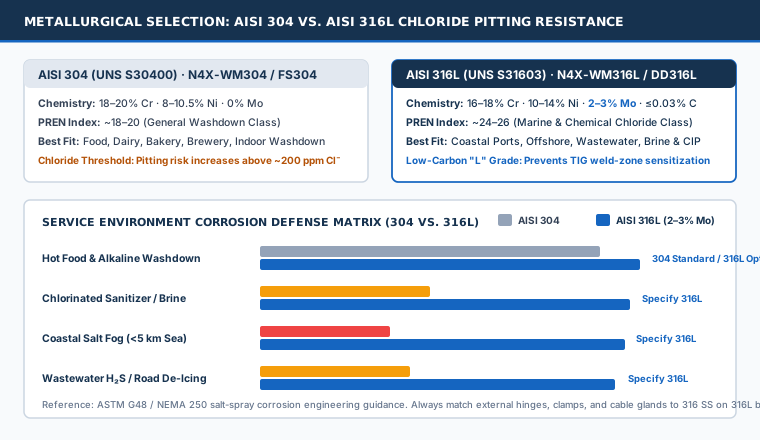
Chemical Composition & Pitting Resistance (PREN)
Stainless steel resists corrosion through a self-healing chromium-oxide passive film. Chloride ions penetrate that film locally, initiating deep crevice and pitting corrosion if molybdenum is absent.
| Metallurgical Property | AISI 304 (UNS S30400) | AISI 316L (UNS S31603) | Engineering Impact |
|---|---|---|---|
| Chromium (Cr) | 18.0–20.0% | 16.0–18.0% | Forms baseline passive oxide barrier |
| Nickel (Ni) | 8.0–10.5% | 10.0–14.0% | Stabilizes austenitic toughness & formability |
| Molybdenum (Mo) | 0% | 2.0–3.0% | Blocks chloride ion breakdown & crevice pitting |
| Carbon Max (C) | ≤0.08% | ≤0.03% (“L” Low Carbon) | Prevents TIG weld-zone chromium carbide sensitization |
| PREN Estimate | ~18–20 | ~24–26 | Higher PREN = stronger salt-fog & brine durability |
| Matching N4X Models | N4X-WM304, N4X-FS304 | N4X-WM316L, N4X-DD316L | Both available with N4X-CNC-CUT |
Application Decision Matrix by Chloride & Sanitizer Exposure
Use the operating thresholds below to select between 304 and 316L stainless enclosures before issuing an approval drawing:
- Specify AISI 304 when operating indoors with hot potable water, mild alkaline/caustic foaming cleaners, neutral detergents, and chloride levels consistently below ~200 ppm at ambient temperatures (bakery, dairy fluid rooms, beverage bottling, dry pharma packaging, meat cutting with fresh-water final rinse). Pair with a 15–20° sloped roof via 304 Stainless Washdown Enclosures.
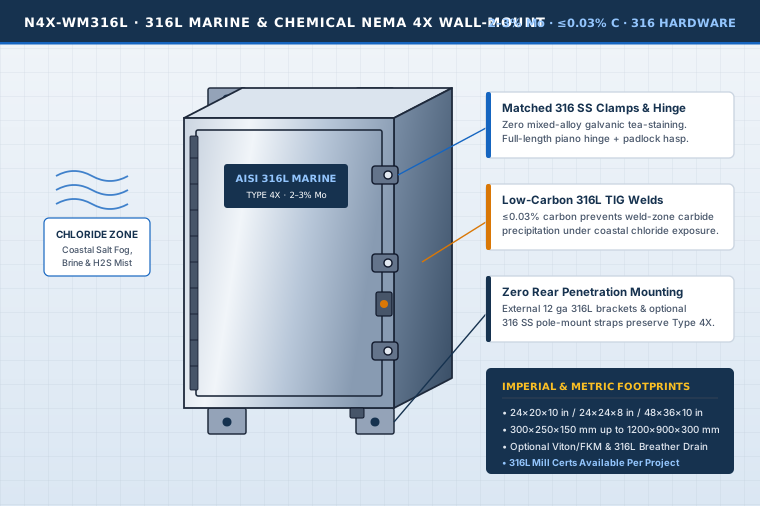
- Specify AISI 316L whenever the enclosure faces coastal air within 5 km of saltwater, direct marine spray, pickling/brine tanks, high-ppm chlorinated CIP sanitizers (sodium hypochlorite or chlorine dioxide), wastewater H₂S headworks, sulfuric/phosphoric acid mist, or winter roadway de-icing salts. Review full hardware matching in 316L Marine & Chemical Enclosures.
- Never Mix External Hardware Alloys: Putting 304 stainless hinges or clamp screws onto a 316L cabinet causes localized galvanic staining right at the door seam. Always specify 100% matched 316 stainless latches, hinges, mounting brackets, and stainless cable glands on 316L cabinets.
Mill Certificate Traceability & Surface Finish
Surface roughness also influences pitting onset: smoother brushed #4 surfaces (Ra ≤ 0.8 µm) shed chloride droplets faster than coarse mill finishes. All N4X enclosures are built to NEMA 250 Type 4X and UL 508A enclosure design requirements; material mill certificates (304/316L) and ingress test reports available per project.
Unsure about your site’s sanitizer chemistry or coastal distance? Share your washdown chemicals and enclosure dimensions for a 15-Minute Formal Quote and engineering alloy review.
Standard & Custom-Engineered Models
304 Sanitary Wall-Mount Sloped Roof
20° sloped-roof AISI 304 wall-mount enclosure (16/14 ga) with continuous poured-in-place PU gasket, concealed hinge, and brushed #4 sanitary finish.
Full Datasheet →304 Free-Standing Washdown Control Cabinet
Floor-standing single-door AISI 304 cabinet (14/12 ga) with 15° sloped roof, 3-point padlockable stainless handle, sanitary leveling feet, and heavy 10 ga sub-panel.
Full Datasheet →316L Marine/Chemical Wall-Mount
AISI 316L molybdenum-alloyed wall-mount enclosure (16/14 ga) with continuous 316 SS piano hinge, screw-down/quarter-turn 316 latches, and seamless poured PU gasket.
Full Datasheet →